

banner-news

Prof. Julius Kaplunov

TDTU Adjunct Professor
Institute for Advanced Study in Technology

Place of work
School of Computing and Mathematics, Keele University, UK

Email
juliuskaplunov@tdtu.edu.vn

Research areas

Mechanics, Applied Mathematics, Acoustics, Engineering, Materials Science

Research activities


Recent Publications/Highlighted Publications

  1.  

Asymptotic continualisation of high-contrast lattices and the interpretation of gradient elasticity

International journal of engineering science (2026)

  1.  

Preface to the Special Issue on “Multiscale Mathematical Modelling”

Mathematics (2026)

  1.  

The Influence of Boundary Conditions on Trapped Modes in Semi-Infinite Elastic Waveguides

Vibration (2026)

  1.  

Dynamics of a FGM thin elastic coating subject to anti-plane shear

Continuum mechanics and thermodynamics (2026)

  1.  

Stephen Timoshenko's letters to Paul Ehrenfest, recently discovered at the museum Boerhaave, Leiden, The Netherlands

Philosophical magazine (2026)

  1.  

On the approximate schemes for the evaluation of the acoustic radiation by a thin elastic layer

Continuum mechanics and thermodynamics (2025)

  1.  

Low-frequency vibrations of a high-contrast orthotropic lattice

Mechanics research communications (2025)

  1.  

Dynamics of a thin elastic coating

International journal of engineering science (2025)

  1.  

Response of a thin coating of a porous elastic material whose generalised Young's modulus depends on the density

Mathematics and mechanics of solids (2025)

  1.  

Multimode long-wave approximation for a viscoelastic coating subject to antiplane shear

Zeitschrift fur angewandte mathematik und physik (2024)

  1.  

Low-frequency propagating and evanescent waves in strongly inhomogeneous sandwich plates

Zeitschrift fur angewandte mathematik und physik (2024)

  1.  

On the refined boundary condition at the edge of a thin elastic strip supported by a Winkler-type foundation under antiplane shear deformation

International journal of engineering science (2024)

  1.  

Transverse Compression of a Thin Inhomogeneous Elastic Layer

Mathematics (2024)

  1.  

Asymptotic Derivation of Consistent thin Shell Equations for a Fluid-Loaded Elastic Annulus

Journal of applied mechanics and technical physics (2024)

  1.  

Transverse compression of a thin elastic disc

Zeitschrift fur angewandte mathematik und physik (2024)

  1.  

A revisit to the plane problem for low-frequency acoustic scattering by an elastic cylindrical shell

Mathematics and mechanics of solids (2024)

  1.  

Elastic bending and transverse compression of a thin plate with density-dependent Young's modulus

International journal of non-linear mechanics (2024)

  1.  

Asymptotic analysis of the axisymmetric problem for the transverse compression of a thin elastic disk in the case of mixed boundary conditions along its faces

Izvestiya of saratov university mathematics mechanics informatics (2024)

  1.  

A hierarchy of asymptotic models for a fluid-loaded elastic layer

Mathematics and mechanics of solids (2024)

  1.  

Discovering asymptotic expansions for problems in mechanics using symbolic regression

Mechanics research communications (2023)

  1.  

Degenerated Boundary Layers and Long-Wave Low-Frequency Motion in High-Contrast Elastic Laminates

Mathematics (2023)

Books

  1.  

Dynamics of Thin Walled Elastic Bodies. Academic Press

1998

  1.  

Edge and Interfacial Resonance Phenomena in Elastic Solids

2010

  1.  

Dynamic Localization Phenomena in Elasticity

2013

  1.  

Modern Trends in Structural and Solid Mechanics (Vol. 1- Statics and Stability, Vol.2 -Vibrations, Vol. 3 -Non-deterministic Mechanics)

2021

  1.  

Advances in Mechanics of Time Dependent Materials

2023

Research projects 

  1.  

NATO-Russia Collaborative Linkage Grant. A dynamic investigation of rock layers to prevent catastrophe. Universities of Manchester and Salford, Research Institute of Comprehensive Exploitation of Mineral Resources, Russian Academy of Sciences, Ural Mining Institute of the Russian Academy of Sciences, Perm.

2001-2003

  1.  

LMS grants to support Professors B.F.Shorr and Y.A.Ustinov visits to Manchester University and Dr E.Its visit to Brunel University.

2001-2008

  1.  

EPSRC Post-Doctoral Research Fellowship (GR/R53692/01). Quasi-fronts in incompressible pre-stressed plates subject to edge point loading.

2002-2003

  1.  

INTAS Post-Doctoral Grant (YSF 2001/1-7) for Dr M.V.Wilde, Saratov State University. Edge and interfacial vibration of thin structures.

2002-2003

  1.  

EPSRC Post-Doctoral Research Fellowship (GR/S29751/01) Justification and refinement of initial value problem for lonq-wave models in thin structures (together with G.A.Rogerson).

2003-2007

  1.  

EPSRC Visiting Fellowship (GR/S11916/01) An asymptotic methodology for non-adiabatic interaction in weakly inhomogeneous elastic wave-guides (together with G.A.Rogerson).

2003-2004

  1.  

British Council. UK-Slovenia Partnership in Science.

2004-2005

  1.  

EPSRC Visiting Fellowship (EP/D038812/2) Wave propagation in anisotropic solids with a weak spatial dispersion to support Prof A.G.Every four-month visit to Brunel University (together with G.A.Rogerson).

2006-2007

  1.  

Strategic Network with Saratov State University, Russia to support PhD, MPhil and MSc students at Brunel and initiate staff training and exchange programs.

2007-2012

  1.  

EPSRC Visiting Fellowship (EP/G000972/1) Exact solutions for elastic surface waves with general lateral dependencies in layered structure ((together with G.A.Rogerson).

2008-2009

  1.  

EPSRC Visiting Fellowship (EP/H021302/1) High-frequency long-wave behavior in elastic waveguides with arbitrary cross-section (together with E.Nolde).

2009-2010

  1.  

Industrial collaborative project with AMSTED Rail, USA including support of a PhD      student at Keele to work on Nonlinear Inverse Problems in Railway Dynamics.

2011-2014

  1.  

Horizon 2020 Fellowship Multi-scale modeling of waves of porous media with applications to                                    acoustic control and bio-mechanic (together with G.A.Rogerson).

2015-2017

  1.  

Industrial collaborative project with AMSTED Rail, USA to support a research associate at Keele in the area of Nonlinear Railway Dynamics.

2015-2016      

  1.  

Erasmus bilateral exchange programs with Armenia. Azerbaijan, Belorussia, Georgia, Kazakhstan, Russia, Ukraine, and Uzbekistan.

2016 – 2020

  1.  

ARRC (Slovenian Research Agency) three-year basic research grant J2-9224 ‘Multiparametric dynamic modelling of layered strongly inhomogeneous elastic structures’ (PI).

2018 – 2021

  1.  

RNF (Russian National Foundation) three-year basic research grant 20-11-20133 ‘Analytical models for seismic metamaterials’ (PI).

2020 – 2022


Collaborative activities

Seminar by Prof. Dr. Julius Kaplunov - "A dynamic theory for a thin functionally graded plate"

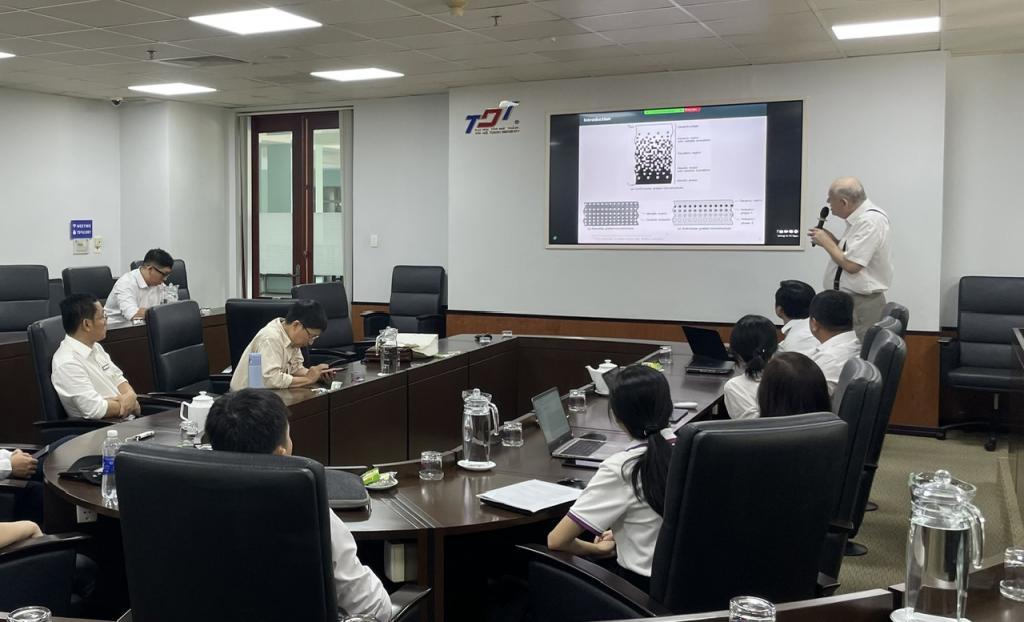
On December 23, 2024, the lectures from Prof. Dr. Julius Kaplunov takes place on the A104 with detailed content as follows:

GS.TS Julius Kaplunov presents about "A dynamic theory for a thin functionally graded plate"

Abstract:

3D dynamic equations in linear elasticity for a transversely inhomogeneous isotropic layer are analysed. The thickness of the layer is assumed to be small in comparison with a typical wavelength, while Young’s modulus, Poisson’s ratio and mass density are defined as arbitrary functions in the transverse variable.  The same asymptotic scaling, as in the homogeneous setup, is adapted for 3D displacements and stresses. In this case, characteristic time and length scales are related to each other as in the classical Kirchhoff theory for plate bending. As usual, all the sought for quantities are expanded in series in terms of a small geometric parameter corresponding to the relative thickness. At leading order, we arrive at a 2D fourth order equation for bending motion taking the same form as that in the Kirchhoff theory to within the expressions for constant coefficients, which are now given by certain integrals across the thickness involving variable problem parameters. The asymmetry of the 3D original problem with respect to the transverse variable results in presence of quasi-static extension governed at leading order by 2D equations similar to those for the generalised plane stress. It is remarkable that, in spite of asymmetry, the aforementioned problem can be decoupled, i.e. the bending sub problem is solved independently from the extension one, whereas the latter is treated with terms determined from the solution of the bending sub problem in its right-hand side. It is also worth noting that the adhoc engineering formulations for functionally graded plates do not take into consideration the possibility of such decoupling leading to differential equations of a doubled order. The next order asymptotic approximation for plate bending is also derived. The equation of motion is still of the fourth order as at the leading order approximation, i.e. it does not support spurious solutions similar to the homogeneous setup. Higher-order corrections come through a mixed fourth order time space derivative. However, the constant coefficients in the refined 2D bending equation are expressed through rather sophisticated multiple integrals across the thickness. Nevertheless, decoupling of bending motions and extension de formations occur at higher order as well. Any comparison with related adhoc refined plate bending does not seem to be fruitful. The point is that the asymptotic cross section thickness variation of the displacement field at higher order nontrivially depends on variable problem parameters and cannot be approximated through simple polynomials typical of many engineering assumptions. In addition, adhoc models usually deal with stress resultants and stress couples and therefore neglect the peculiarities of the cross-thickness variation of the stress field, which is of particular importance namely for functionally graded structures. The developed asymptotic framework is also valid for layered plates with piecewise uniform problem parameters. It also allows various extensions, including analysis of functionally graded shells, coatings and interfacial layers.
122